

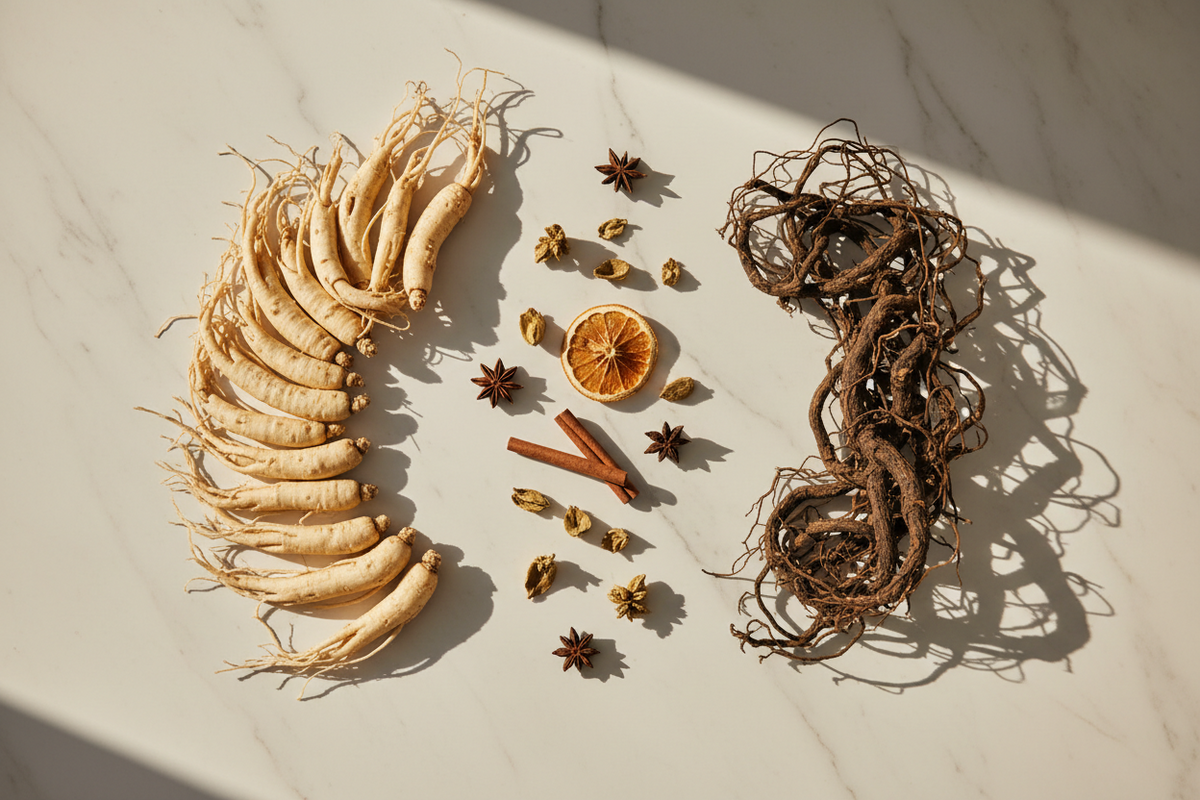
There are certain ingredients that seem to carry more meaning than their physical form should allow.
Ginseng is one of them.
A root, technically. Often twisted, pale and almost human-looking, with a shape that seems to invite metaphor. It appears in glass jars, tonics, teas, capsules, extracts, skincare, gift boxes, luxury sets and convenience-store drinks. In Korea, it can feel both ancient and entirely modern: something found in traditional medicine shops, department stores, airport duty free, beauty counters and wellness aisles. Ginseng is not only consumed, but rather it is interpreted.
It is understood through ideas of strength, stamina, restoration, prestige, care, age, vitality, inheritance and resilience. It is given to parents, bought for elders, taken during periods of fatigue, folded into beauty products, offered as a serious gift, and increasingly reformatted into the language of modern wellness.
The question is not only what ginseng contains. The more interesting question is what people have wanted it to mean. The root that looks like a body. Part of ginseng’s symbolic power comes from the root itself.
It does not look neutral. It looks bodily. Limbed, and some may say strange and occasionally human. That visual quality has mattered historically, because many food and medicinal traditions have attached meaning to resemblance. A plant that looks like a body becomes easier to imagine as something that speaks to the body.
This is not scientific evidence, of course. Resemblance does not prove effect. But anthropologically, it helps explain why certain plants become culturally powerful. Their appearance gives people a language for imagining their relationship with the body.
History.
In East Asian traditions, ginseng has long occupied a particular status as a valued root associated with restoration and strength. In Korea especially, red ginseng carries a seriousness that is quite different from the way many Western supplements are consumed. It is not simply a product. It often sits inside ideas of care, age, endurance and respect.
A box of red ginseng can be a gift in a way that a bottle of tablets rarely is. That difference matters. When an ingredient becomes giftable, it has moved beyond function. It has entered social life. Red ginseng and the language of care. Korean red ginseng is perhaps the most culturally recognisable form of ginseng today.
The “red” does not mean it is a different species. It refers to the way the root is processed, usually through steaming and drying, which changes its colour, texture and character. White ginseng and red ginseng may begin from the same plant, but they arrive in culture differently. Red ginseng feels more ceremonial and deliberate.
It is often packaged with the visual language of value: deep reds, golds, lacquered boxes, roots suspended in liquid, extracts portioned into small vials or sachets. It does not pretend to be casual. It asks to be treated as something important.
What interests me is how easily red ginseng moves between old and new Korea.
It belongs to traditional medicine, but also to airport retail. It belongs to elders, but also to beauty. It belongs to fatigue, but also to performance. It belongs to gifting, but also to self-optimisation. That ability to move between worlds is part of its power. Wild ginseng and the fantasy of rarity. Then there is wild ginseng.
Wild Gingseng.
Wild ginseng carries a different kind of meaning. If red ginseng is seriousness, wild ginseng is almost myth. It suggests mountain, difficulty, age, rarity and discovery. It belongs to the imagination of the root found rather than produced. That matters because rarity changes how we value food. A cultivated root can be a product. A wild root becomes a story.
Across cultures, humans have always placed unusual value on foods that are difficult to obtain: truffles, saffron, wild herbs, rare teas, aged ferments, forest mushrooms, mountain honey. The difficulty becomes part of the meaning. The labour of finding becomes part of the value. Scarcity becomes a kind of aura.
Wild ginseng sits exactly there. Its value is not only botanical. It is narrative.
It carries the idea that some forms of vitality cannot be manufactured quickly. They must be found, waited for, aged, protected and extracted from the mountain rather than produced by the market. Of course, the market eventually finds that too. What people think ginseng does.
Across different parts of the world, people have understood ginseng through slightly different languages.
In Korea and China, it has long been connected to ideas of vitality, restoration, endurance and balance. In traditional medicine contexts, it is often discussed as a tonic, something associated with strengthening the body during weakness, age, recovery or depletion.
In Europe, ginseng root preparations are recognised as traditional herbal medicinal products for symptoms of asthenia, such as fatigue and weakness. That wording matters. Traditional medicinal use means the indication is based on long-standing use, not on the same level of evidence required for a clinically proven treatment. It is a careful category: neither dismissive nor exaggerated.
In the West more broadly, ginseng has often been absorbed into the language of energy and performance. It appears in supplements, functional drinks, nootropic blends, skincare, immune-positioned products and “adaptogen” formulas. The vocabulary changes, but the underlying desire is familiar: more resilience, more stamina, more capacity to cope.
Every culture has its own way of naming exhaustion, and every culture develops objects that promise, symbolically or practically, to answer it. Ginseng has survived as one of those objects because it speaks to a very old human wish: the desire to feel restored. From tonic to wellness product. The modern wellness industry has not invented the desire for vitality. It has inherited it, packaged it and accelerated it.
It would be easy to say that wellness culture has simply commercialised ginseng. And of course, to some extent, it has. But ginseng was never outside commerce. It has been traded, gifted, cultivated, prized and packaged for centuries. Its value has always been economic as well as symbolic.
What has changed is the format.
The root becomes an extract. The extract becomes a sachet. The sachet becomes a beauty drink. The beauty drink becomes a social media product. The traditional tonic becomes an ingredient in a smoothie, a gummy, a serum, a capsule, a functional beverage. The old meaning does not disappear, but rather, it is translated. Sometimes beautifully, sometimes reductively, often both at once.
Ginseng has been studied for fatigue, cognitive performance, immune function, metabolic markers and other outcomes, but the evidence is not simple enough to support grand wellness claims. Some reviews describe ginseng as promising for fatigue, particularly in certain populations, but also call for stronger and more diverse research before it is treated as a standard intervention.
Promising does not mean proven and traditional use does not mean useless. Limited evidence does not mean no effect and good science often lives in this more careful middle ground.
It is also worth saying that ginseng is biologically active. That is part of why people use it, and part of why it should not be treated casually. It may be unsuitable for some people, including during pregnancy or breastfeeding, and it can interact with certain medications, including medicines affecting blood sugar, blood pressure or blood clotting. Anyone considering ginseng for a specific health concern should speak to a qualified healthcare professional.
The wellness question.
As someone who runs a wellness brand, I think about this carefully.
Kurami exists inside the same cultural landscape: nourishment, function, ritual, plant ingredients, beauty, convenience and the desire to make looking after oneself easier and more pleasurable. I am not standing outside this world pretending I have no part in it. But ginseng raises a useful question.
What happens when an ingredient with deep cultural meaning becomes part of the global wellness vocabulary?
Something is gained. More people discover it. More formats become available. A traditional ingredient finds new life. A root that once belonged to a specific medical and cultural world becomes part of a wider conversation about fatigue, beauty, resilience and ageing. But something can also become thinner. A root that once carried a whole philosophy of restoration becomes “energy”. A practice of care becomes a product benefit. A gift becomes a claim. A long cultural history becomes an ingredient list.
This is not a reason to reject modern wellness products. It is a reason to treat them with more context. What ginseng reveals about us. I think ginseng remains powerful because modern life has made vitality feel both desirable and fragile.
People are tired. Not only physically tired, but cognitively tired, emotionally tired, metabolically tired, socially tired. It makes sense that ingredients associated with restoration continue to appeal.
But the older lesson of ginseng may not be that one root can solve exhaustion.
Perhaps the lesson is that cultures have always understood vitality as something precious. Something to be protected, that declines when life asks too much of the body for too long.
That is very different from the modern idea that vitality is simply something we can purchase, optimise or extract from a supplement routine.
At Kurami, the idea of vitality interests us, but not as a dramatic promise. More as a rhythm. Enough food. Enough plants. Enough pleasure. Enough repetition. The kind of nourishment that does not ask the body to become extraordinary, but supports it in being lived in.
Ginseng, in all its forms, tells us something beautiful about the human desire to be restored. But perhaps it also reminds us that restoration was never meant to come only from a product.
It was meant to come from a way of living that did not leave the body perpetually asking to be repaired.
FAQs
What is ginseng?
Ginseng is a root from plants in the Panax genus, most famously Panax ginseng, often called Asian or Korean ginseng. It has long been used in East Asian herbal traditions and is now found in teas, extracts, capsules, drinks, skincare and functional foods.
What is the difference between red ginseng and white ginseng?
Red and white ginseng usually refer to different preparations of Asian ginseng. Red ginseng is typically steamed and dried, while white ginseng is dried without the same steaming process. The preparation changes the root’s colour, texture, chemical composition and cultural meaning.
What is wild ginseng?
Wild ginseng grows naturally rather than being cultivated. It is rare, highly valued and often surrounded by cultural ideas of age, potency, mountain terrain and difficulty of harvest. Its rarity is part of its symbolic and economic value.
What do people traditionally use ginseng for?
In traditional contexts, ginseng has often been associated with vitality, restoration, weakness, fatigue, endurance and resilience. In Europe, ginseng root preparations are recognised as traditional herbal medicinal products for symptoms of asthenia such as fatigue and weakness, based on long-standing use rather than clinical evidence.
Is ginseng good for you?
Ginseng is widely used and studied, but it should not be treated as a cure-all. Its effects can vary depending on the type, preparation, dose and individual. It may also interact with some medications or be unsuitable for some people, including during pregnancy or breastfeeding. Anyone using ginseng for a specific health concern should seek advice from a qualified health professional.
Is ginseng an adaptogen?
Ginseng is often described as an adaptogen in wellness and herbal medicine contexts, meaning it is associated with helping the body respond to stress. However, “adaptogen” is not the same as an authorised health claim, and the evidence varies depending on the preparation, dose and outcome studied. It is better to treat the term as a traditional and commercial category rather than a guarantee of effect.
Why is Korean red ginseng so culturally important?
Korean red ginseng is culturally important because it sits at the intersection of health, gifting, age, respect and care. It is not only consumed for its perceived function. It is also given as a meaningful object, often associated with elders, resilience and restoration.
What does ginseng reveal about modern wellness culture?
Ginseng reveals how modern wellness often takes older symbols of restoration and translates them into products, claims and routines. It also shows that the desire for vitality is not new. What is new is how quickly ancient ingredients are now reformatted into global wellness language.
Sources and further reading.
European Medicines Agency. Ginseng radix: herbal medicinal product monograph and public summary.
So, S. H. et al. Red ginseng monograph. Journal of Ginseng Research. 2018.