

For years, the Western gut-health conversation has been dominated by a very simple image: live bacteria travelling into the body and doing something good.
It is an appealing idea, and not an unreasonable one. Probiotics became the star of the microbiome world because they felt alive, active and almost hopeful. A yoghurt, a capsule, a spoonful of kefir, a small bottle taken in the morning, each one carrying the promise that the gut might be repopulated, rebalanced or restored by adding life back into it.
There is truth in that story, but it is not the whole story. Food cultures with a longer and more ordinary relationship to fermentation often seem to understand microbes in a less literal way. They are not only interested in whether a bacterium is alive when it enters the mouth. They are also interested in what fermentation has done to the food, what the microbes have produced, how flavour and digestibility have changed, and how a daily ritual fits into the body over time.
Japan is a useful place to look at this because its relationship with fermented foods and lactic acid bacteria is both very old and very modern. On one side, there is miso, soy sauce, natto, tsukemono, sake, mirin, amazake and koji, foods and processes that belong to the kitchen, the season, the table and the ordinary rhythm of eating. On the other side are highly developed functional drinks, lactic acid bacteria products, health claims, food science, and postbiotic ingredients that belong very much to contemporary consumer culture.
So when people ask whether Japan focuses more on postbiotics than probiotics, the answer has to be careful. Japan has not abandoned probiotics, and it would be wrong to pretend that live bacteria are not part of the culture. Yakult alone shows how deeply Japan has shaped the global probiotic imagination. But Japan has also been more comfortable than many Western wellness markets with the idea that microbes do not always need to be alive to matter, that is where postbiotics enter the conversation.
A postbiotic is often described online as a “dead probiotic,” which is technically convenient but a little crude. The more precise definition, used by the International Scientific Association for Probiotics and Prebiotics, is a preparation of inanimate microorganisms and/or their components that confers a health benefit on the host. In simpler language, the microorganism may no longer be alive, but parts of it, or substances associated with microbial activity, may still interact with the body in a meaningful way.
This changes the mood of the conversation. It moves us away from the romance of “live cultures” and towards something more subtle: sometimes the benefit may not come from the organism still being alive, but from the work it has already done. Japan did not suddenly discover gut health.
One reason the Japanese gut-health conversation feels so useful is that fermentation there does not sit like a wellness accessory placed on top of the diet. It belongs much more naturally to the structure of eating.
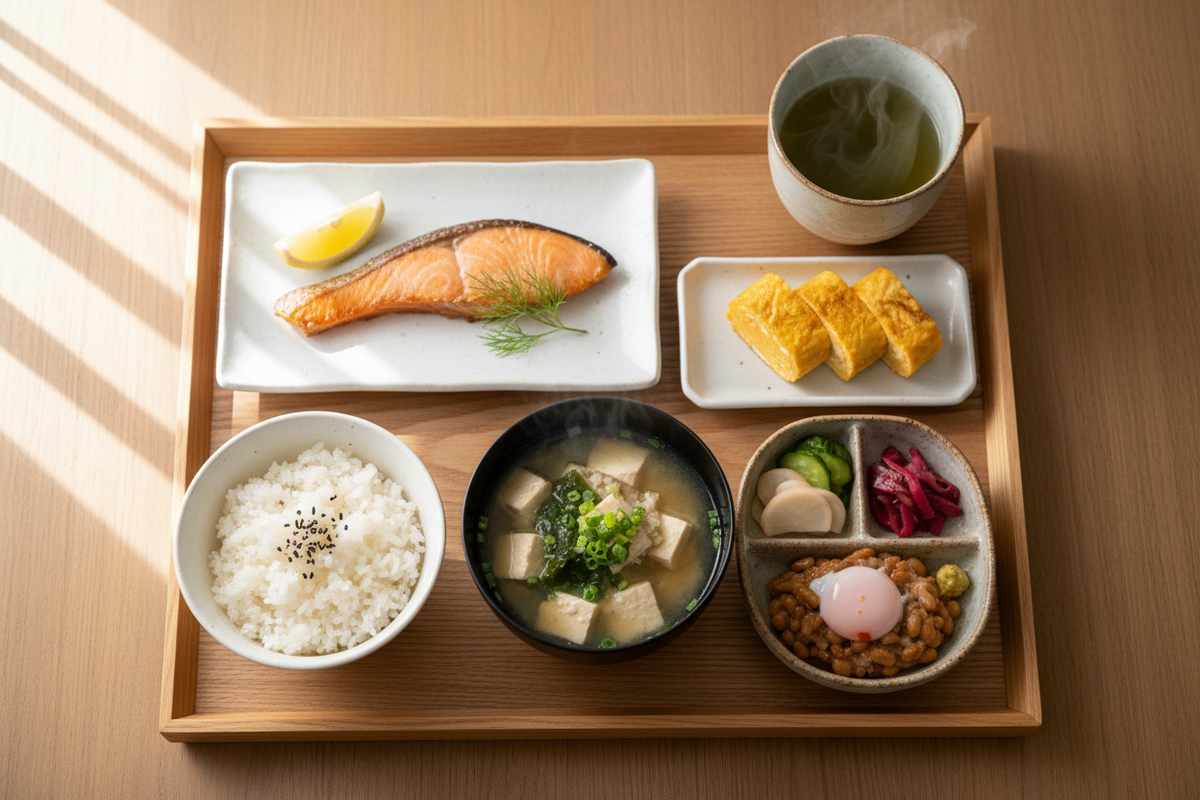
Of course, Japan is not one single food culture, and modern Japanese diets are as varied, globalised and commercial as anywhere else. But there is still a deep familiarity with fermentation as part of food rather than as a separate lifestyle category. Miso soup is not usually presented as a gut-health hack. Natto is not only a microbiome trend. Koji is not merely an ingredient discovered by chefs and supplement companies. These foods belong to taste, preservation, routine, seasonality, economy, digestion, memory and the particular intelligence of turning simple ingredients into something more complex through time.
Coming from an Italian background, I understand this through my own relationship with food traditions that are not always explained through modern nutrition, even when nutrition later finds language for them. Olive oil, bitter greens, beans, artichokes, sourdough, anchovies, vinegar, long-cooked vegetables, broths, fruit at the end of a meal. These things were not introduced to me as “functional foods.” They were simply part of how eating made sense.
That distinction matters because in many Western markets, gut health often arrives as a product before it arrives as a food habit. A capsule, a fibre powder, a kombucha bottle, a greens powder, a supplement stack, a protocol. In Japan, the microbial world has long been present in ordinary foods and drinks, which may be one reason the culture has also been open to thinking beyond the simple live-bacteria story.
The question becomes less narrow, as it is not only: are the bacteria alive? But also: what has microbial activity changed, produced, softened, transformed or left behind?
Probiotics, prebiotics and postbiotics are not enemies. The language can become confusing, especially because wellness tends to introduce one word at a time and then make it sound like the missing answer.
But the body does not live according to marketing cycles, and these categories are not in competition with each other. Probiotics are live microorganisms that, when given in adequate amounts, confer a health benefit. Prebiotics are substrates, often certain fibres or plant compounds, that beneficial microbes can use. Postbiotics are preparations of inanimate microorganisms and/or their components that can still confer a health benefit.
In ordinary language, probiotics are the microbes, prebiotics are part of what feeds them, and postbiotics are part of what microbes or microbial processes leave behind. A good food culture does not need to choose one and discard the others. A meal rich in plants, seaweed, beans, rice, vegetables, fermented ingredients, herbs, protein and fibre may touch several parts of this microbial story at once. The live organisms may matter in some contexts. The fibres and substrates matter. The compounds created by fermentation matter. The wider pattern of eating matters perhaps most of all.
This is why the Japanese approach feels helpful. It feels less theatrical than much of Western wellness culture. It does not always need the microbe to be alive to respect the work of microbes.
The practical appeal of postbiotics.
Postbiotics also make sense for very practical reasons, which is probably part of why food companies and researchers are paying so much attention to them.
Live bacteria can be fragile. They may be affected by heat, oxygen, acidity, storage, transport, manufacturing and time. Anyone who has bought an expensive probiotic and wondered whether it still contains what the label promised has already understood the problem. Postbiotics do not depend on the microorganism being alive at the moment of consumption, which makes them easier to use in foods, drinks, powders, tablets, and products that have to survive real life: shelves, shipping, handbags, heat, forgetting, travelling, opening, and closing.
We want food to be alive, but also stable. Natural, but also standardised. Ancient, but also clinically studied. Traditional, but also convenient enough to take through an airport.
Japan’s food science seems to have understood this tension earlier than many Western wellness markets. Heat-killed lactic acid bacteria, inanimate microbes and specific lactic acid bacteria ingredients have been studied and used in functional products for years. Kirin’s Lactococcus lactis strain Plasma, described by the company as a postbiotic, is one example of how a Japanese company has positioned a lactic acid bacteria ingredient within immune-function products. More broadly, Japan’s Foods with Function Claims system has encouraged companies to build evidence around lactic acid bacteria and bifidobacteria, including strains used in functional foods and drinks.
This does not mean every postbiotic product is automatically useful, or that the word should be treated as a guarantee. It only means that Japan has created a food and regulatory culture where microbial function can be considered more broadly than “live bacteria or nothing.”
Antibiotics, stomach acid and the new gut-health shelf.
This is where the conversation becomes very contemporary, because the gut-health products arriving in the UK now are not quite the same as the older probiotic capsules many of us grew up seeing in the pharmacy.
For a long time, the probiotic story was sold very simply: swallow live bacteria and let them reach the gut. It is a lovely image, but the reality is more complicated. The stomach is acidic for a reason. It is one of the body’s first defences, and live bacteria have to pass through acid, bile, storage, heat, time and manufacturing before they can reach the intestine in meaningful numbers. That does not mean probiotics are useless, and it would be wrong to say they are all destroyed before they arrive. Some strains survive better than others, some products are tested for survival, some work partly through transient effects rather than permanent colonisation, and food itself can sometimes help protect microbes on the way through, but delivery still matters.
This is why the newer generation of encapsulated probiotics feels culturally revealing. In the UK, we are only recently becoming more familiar with probiotics that talk seriously about protection through the stomach, delayed release, targeted delivery and strain survival, rather than simply promising “billions of live cultures” as though the number alone were enough. The language has changed because consumers have become more sophisticated, but also more doubtful. People no longer only ask whether a product contains bacteria. They ask whether those bacteria survive, where they go, and what they actually do once they get there.
Postbiotics enter this landscape with a different kind of promise. Because they do not rely on the microorganism being alive at the point of consumption, they sidestep part of the survival question. They are not trying to colonise the gut in the same way. They focus on microbial components, fermentation-derived compounds, and the biological signals left behind by microbial activity.
This is why brands such as GutLEx, which positions itself around Japanese postbiotic science and a Lactobacillus Fermentation Extract, feel very much of the moment. Whether you look at GutLEx as a specific product or simply as a sign of where the category is going, it shows how the gut-health conversation is moving from “live bacteria” toward microbial work: metabolites, organic acids, peptides, cell fragments, and compounds produced through fermentation.
Antibiotics make this shift even more relevant. Antibiotics can be necessary and sometimes life-saving, so I dislike how wellness culture sometimes talks about them as though they are simply bad. But they are also blunt instruments, and they can disrupt the gut's microbial ecology. One thing that can be affected is the production of short-chain fatty acids, such as acetate, propionate, and butyrate, which are normally produced when gut microbes ferment fibres and other non-digestible carbohydrates.
These short-chain fatty acids are part of the quiet chemistry of gut health. Butyrate, in particular, is often discussed because it helps fuel the cells lining the colon and participates in gut barrier and immune signalling. So after antibiotics, the question is not only how to “put bacteria back.” It is how to support the return of microbial function, which also means feeding the gut ecosystem with fibre, plants, enough food, regular meals and time.
Some early research looks at postbiotics during antibiotic treatment, including small human studies on fermentation-derived postbiotics and microbiome stability, but the field is still young and very product-specific. I would be careful not to turn this into another universal rule. Not everyone needs the same probiotic, postbiotic or protocol after antibiotics, and persistent symptoms should always be discussed with a clinician. But culturally, the direction is revealing: we are moving from a very simple model of “add live bacteria” towards a more ecological model of gut recovery.
That feels much closer to the Japanese way of thinking about fermentation, which focuses not only on the organism and the ingredient, but rather on the work it performs, the compounds it leaves behind, the environment it enters and the pattern that allows the gut to recover.
A quieter microbiome conversation.
The Western microbiome conversation can be very loud. Heal your gut. Reset your microbiome. Fix your bloating. Repair your gut lining. Take this strain. Avoid that food. Add this powder. Change your life in seven days.
Some of this language comes from real science, but much of it becomes exaggerated once it enters marketing. It can make the gut feel like something permanently broken, something that has to be managed, corrected and optimised with every meal.
What I like about the postbiotic conversation, when it is handled well, is that it opens the possibility of a quieter view. Fermentation is not magic. A probiotic is not always a solution. A postbiotic is not a miracle. But microbes, fibres, fermentation products, plant compounds and daily food patterns may all participate in a larger ecology of the body. The gut is not a machine that needs one missing part added back in, but rather it is an ecosystem, and ecosystems respond to patterns.
That is also how we think at Kurami. Gut health is not one capsule, one ingredient or one heroic food. It is repetition, fibre, plant diversity, enough protein, fermented foods if tolerated, regular meals, hydration, sleep, stress, and enough pleasure for the pattern to be sustainable. It is also medical care when symptoms are persistent, because not every digestive issue should become a lifestyle project.
Postbiotics are useful because they remind us that gut health is not only about adding live microbes. It is also about what microbes produce, what our food allows them to produce, and how the body responds over time.
Microbial work.
Probiotics made us focus on the living organism. Postbiotics ask us to look at what microbes have done. A fermented food is not valuable only because it may contain live bacteria. Fermentation can change taste, texture, acidity, aroma, digestibility and bioactive compounds. It can make soybeans into miso or natto, rice into koji, cabbage into pickles, milk into yoghurt, grains into alcohol, vegetables into something sharper, deeper and more durable. Fermentation is labour, which is invisible, patient and transformative. Postbiotics, in a way, are one trace of that labour. This conversation asks us to stop imagining microbes only as tiny workers we swallow alive, and to think instead about the whole chain of transformation: food, fermentation, bacterial components, metabolites, fibre, host response, daily habit, culture.
Why this is becoming global.
Japan’s approach is becoming more relevant globally as the gut-health market matures. At first, many people wanted probiotics. Then they learned about prebiotics. Now postbiotics are entering the conversation, partly because they promise stability, specificity and convenience, but also because consumers are beginning to understand that the microbiome is not as simple as “more bacteria is better.” This is where globalisation becomes visible. Japanese lactic acid bacteria research, Korean fermented-food culture, European microbiome science, American supplement marketing, British gut-health media and social media wellness language all begin to overlap. Ideas that develop in one food-science culture travel into another, sometimes bringing nuance and sometimes flattening into claims.
Miso becomes a gut-health hack.
Natto becomes a longevity food.
Koji becomes a chef ingredient.
Postbiotics become a powder.
There is nothing automatically wrong with this. Food knowledge has always travelled. Ingredients migrate, techniques migrate, words migrate, cravings migrate. But something does change when a practice is removed from its everyday context and reintroduced as a branded solution.
This is why I think we need both science and anthropology. Science helps us ask what works. Anthropology helps us ask what happens when a food practice moves from one culture into another and becomes a product, a claim, a supplement, a trend or a daily ritual, and what this says about modern people. The rise of postbiotics says a lot about the way people live now.
People want gut health, but they also want convenience. They want science, but they also want tradition. They want naturalness, but they also want shelf stability. They want ancient fermentation, but in a sachet that can survive a commute. They want the reassurance of microbes, but without always dealing with the unpredictability of live organisms.
Modern life makes consistency difficult. People travel, work late, eat irregularly, eat alone, feel confused by food advice and want something simple that feels supportive. A stable postbiotic product can make sense in that world. But there is also a danger in thinking that the newest biotic word is the answer.
What Kurami takes from Japan’s postbiotic culture.
At Kurami, we are drawn to this Japanese way of thinking because it feels less binary.
Not probiotics versus postbiotics.
Not live versus dead.
Not food versus supplement.
Not tradition versus science.
The more useful question is how all of these pieces fit into a way of eating that actually supports the person. A meal can contain fibre that feeds the microbiome. It can include fermented ingredients that bring flavour and microbial history. It can provide protein so the body feels held. It can include plants, herbs, colour, acidity and texture so the meal feels pleasurable rather than medicinal. It can reduce food noise because the work has already been done with care.
Postbiotics may become an important part of the gut-health conversation, but they should not become another isolated object of obsession. They are one more reminder that the body is ecological rather than mechanical, and that food works through relationship: between microbes and fibres, between fermentation and flavour, between daily rhythm and long-term health, between science and culture. Japan’s contribution is not simply that it has postbiotic products. It shows us a different imagination of gut health, one where microbes are not only alive or dead, useful or useless, fashionable or irrelevant, but part of a much older relationship between food, transformation, and the body. The future of gut health may not be only about adding more live bacteria, but it may be about understanding microbial work more deeply.
Camilla Pigozzi Garofalo studied social anthropology and the anthropology of food before founding Kurami, a gut-health meal delivery company focused on plant diversity, balanced nutrition, and sustainable ways of eating. She writes about food culture, eating rituals and the relationship between nutrition and everyday life.
FAQs
What are postbiotics?
Postbiotics are preparations of inanimate microorganisms and/or their components that confer a health benefit on the host. They may include non-living microbial cells, cell fragments or compounds associated with fermentation or microbial activity.
Are postbiotics the same as probiotics?
No. Probiotics are live microorganisms that confer a health benefit when consumed in adequate amounts. Postbiotics do not need the microorganisms to be alive, although they still come from microbial cells or microbial activity.
Does Japan focus on postbiotics more than probiotics?
Japan has a long history with probiotics, fermented foods and lactic acid bacteria, so it would be wrong to say Japan has moved away from probiotics entirely. What makes Japan distinctive is that its food-science and functional-food culture has also been more open to heat-killed lactic acid bacteria, inanimate microbes and postbiotic-style ingredients than many Western wellness markets.
Are postbiotics better than probiotics?
Not necessarily. They are different. Probiotics, prebiotics and postbiotics may all have roles depending on the strain, ingredient, product, dose, evidence and person. Postbiotics may be more stable in some products because they do not rely on live organisms, but that does not mean every postbiotic product is automatically beneficial.
Do probiotics survive stomach acid?
Some probiotics can survive stomach acid and bile, especially depending on the strain, dose, food matrix and formulation, but survival varies. It is too simplistic to say all probiotics are destroyed before reaching the intestine. It is more accurate to say that delivery matters, which is why encapsulated probiotics, delayed-release capsules and strain-specific testing have become more prominent.
What are encapsulated probiotics?
Encapsulated probiotics are probiotic products designed to help protect live microbes from conditions such as stomach acid, bile, oxygen, moisture or heat, depending on the technology used. They are part of a newer generation of gut-health products that focus not only on the number of bacteria, but on survival, delivery and function.
Can postbiotics help after antibiotics?
Antibiotics can disturb the gut microbiome and may affect microbial functions such as short-chain fatty acid production. Some early research is looking at postbiotics during or after antibiotics, but the evidence is still product-specific and developing. After antibiotics, it is usually more useful to think about gut recovery as a pattern: fibre, plant diversity, enough food, regular meals, time and medical advice if symptoms persist.
What are short-chain fatty acids?
Short-chain fatty acids, including acetate, propionate and butyrate, are compounds produced when gut microbes ferment fibres and other non-digestible carbohydrates. They are part of the gut’s normal chemistry and are involved in processes such as gut barrier function, immune signalling and colon-cell energy.
What foods contain postbiotics?
Fermented foods may contain microbial by-products and compounds created during fermentation, although the exact content varies widely by food, processing and storage. Examples include miso, yoghurt, kefir, kimchi, sauerkraut, natto and other fermented foods. Some postbiotics are also used as specific ingredients in functional foods and supplements.
What is Kurami’s view on postbiotics?
Kurami’s view is food-first and pattern-first. Postbiotics are a valuable part of the gut-health conversation, but they should sit within a wider pattern that includes fibre, plant diversity, enough protein, fermented foods if tolerated, good meal structure and medical advice where symptoms are persistent.
Sources & further reading.
ISAPP, Consensus statement on the definition and scope of postbiotics
ISAPP, A postbiotic is not simply a dead probiotic
Consumer Affairs Agency of Japan, Foods with Function Claims database
Kirin Holdings, Lactococcus lactis strain Plasma