
There is an oil that has been sitting in Korean and Japanese kitchens for generations, quietly and deliciously doing what the wellness industry now often tries to sell back to us in capsule form. It is pressed from the seeds of the perilla plant, a member of the mint family, and in Korean it is called deulgireum. In Japan, egoma oil comes from the same botanical family as culinary practice. If you have eaten good Korean food, you may well have tasted it, even if you did not know its name.
I find perilla oil interesting precisely because it does not need to be dressed up as a miracle ingredient. It is a culinary fat with a long food history, a distinctive flavour, and a genuinely notable nutritional profile. Its value lies in that combination: taste first, nutrition in context, and no need for exaggeration.
What it is.
Perilla oil is pressed from the seeds of Perilla frutescens, a plant cultivated across parts of East Asia. The leaves are eaten too, often wrapped around grilled foods, pickled, or used as an aromatic herb, but the oil is its own distinct thing: nutty, toasty, deeply aromatic, closer in spirit to roasted sesame oil than to a neutral cooking oil.
Nutritionally, the notable feature is its fat composition. Perilla seed oil is consistently reported as one of the richest plant sources of alpha-linolenic acid, or ALA, an essential omega-3 fatty acid, with published analyses commonly placing ALA at more than half of total fatty acids. That does not make it medicinal. It simply makes it an interesting traditional oil in a modern food environment where many people eat relatively little plant omega-3.
What the evidence actually says.
The honest position is modest. ALA is an essential fatty acid, meaning the body cannot make it and must obtain it from food. Under the EU authorised health-claims register, ALA contributes to the maintenance of normal blood cholesterol levels, provided the stated condition of use is met. That is a credible claim precisely because it is measured and specific.
Perilla oil is not a cure for anything. Nor is it a full replacement for the long-chain omega-3 fatty acids found in oily fish, because the body converts plant-based ALA into EPA and DHA inefficiently. The sensible view is that perilla oil can contribute to dietary omega-3 intake as part of a varied diet, especially for people who enjoy East Asian cooking, rather than acting as a capsule in culinary disguise.
How it is actually used.
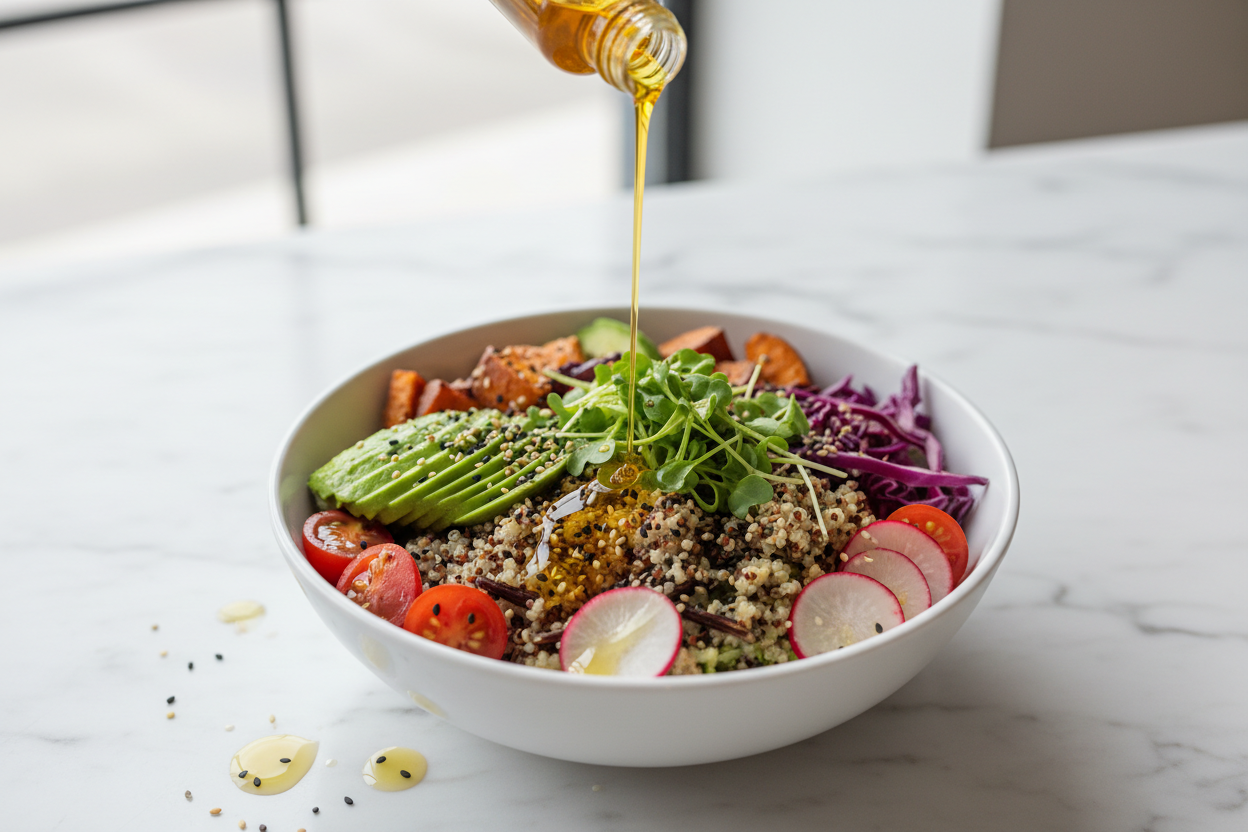
The anthropologically interesting part is how perilla oil is used. It is not usually treated as a high-heat frying oil. Its aromatic value means it is often added as a finishing oil: drizzled over namul, stirred through rice, brushed over grilled seaweed, or added at the end of cooking, where its flavour and delicate fats are better preserved.
This is the quiet intelligence of cuisine. The practice protects the ingredient because the flavour demands it. Nutrition science later gives us another reason to respect the same technique. Traditional food knowledge often works like this: not as a laboratory protocol but as a set of repeated gestures that make food taste better and sometimes align beautifully with what we later come to understand biologically.
Why this matters for how we eat.
Perilla oil is a small lesson in a larger idea. Sensible nutrition is often already embedded in food cultures, arrived at through habit, seasonality, economy and taste rather than through spreadsheets. You do not need to treat perilla oil as medicine. You can use it as it has long been used: a delicious finishing oil that also brings a useful fat profile.
At Kurami, this is the kind of culinary wisdom we find most compelling. Plant diversity, fermented foods, sea vegetables, herbs, pulses and aromatic fats should not feel like wellness decorations placed on top of a meal. They should be built into the cooking logic.
Camilla Pigozzi Garofalo studied social anthropology and the anthropology of food before founding Kurami, a gut-health meal delivery company focused on plant diversity, balanced nutrition, and sustainable ways of eating. She writes about food culture, eating rituals and the relationship between nutrition and everyday life.
FAQs.
What is perilla oil used for?
Perilla oil is usually used as a finishing oil in Korean and Japanese cooking, especially over seasoned vegetables, rice, seaweed and noodles. Its flavour is strong and aromatic, so a small amount can season a whole dish.
Is perilla oil healthy?
Perilla oil is rich in alpha-linolenic acid, an essential plant omega-3 fatty acid. In the EU, ALA is authorised for the claim that it contributes to the maintenance of normal blood cholesterol levels, when consumed in the required amount as part of a balanced diet.
Can perilla oil replace fish oil?
Not exactly. Perilla oil provides ALA, while oily fish provide longer-chain omega-3 fats, EPA and DHA. The body can convert some ALA into EPA and DHA, but conversion is limited, so perilla oil is best understood as a useful contributor rather than a complete replacement.
Sources and further reading
1. European Commission EU Register of Health Claims: alpha-linolenic acid and normal blood cholesterol.