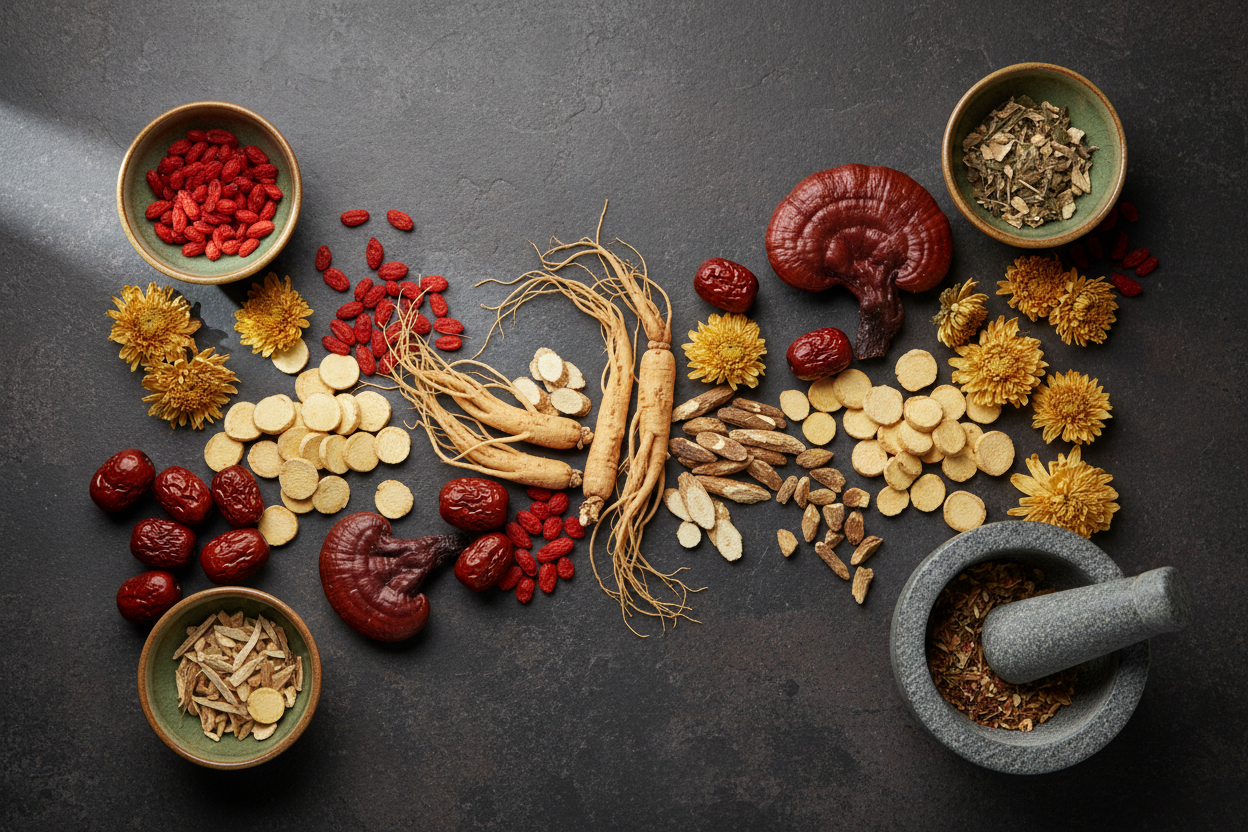
For centuries, traditional Chinese medicine has placed digestion at the centre of how the body is understood. Within that framework, the Spleen and Stomach systems are not treated as isolated organs performing mechanical tasks. They are part of a wider picture of nourishment, energy, resilience, clarity and daily rhythm.
What interests me about this is not the temptation to ask whether traditional Chinese medicine was “right” in modern scientific terms. Traditional medical systems should not only be valued when they can be translated neatly into contemporary biological language. They are also cultural systems: ways of observing the body, organising daily life and making sense of the relationship between food, emotion, environment and care.
In traditional Chinese medicine, digestion is not simply about breaking food down. It is about transformation. Food becomes energy. Warmth supports movement. Regularity supports balance. The body is seen as something shaped by seasons, stress, tiredness, constitution, age, climate and routine. Eating is therefore never purely nutritional. It is part of how a person stays in rhythm with themselves and the world around them.
That feels very different from the way modern wellness often talks about gut health.
Today, digestion is frequently reduced to symptoms, supplements, microbiome tests, probiotics, bloating hacks and the promise of optimisation. There is value in modern science, of course, but the language can become narrow. The gut becomes a site to fix. Food becomes a set of levers to pull. The body becomes a project.
Traditional Chinese medicine offers another kind of lens. It asks not only what a food contains, but how it lands. Is it warming or cooling? Is the person depleted or overstimulated? Is the meal grounding? Is the body being asked to digest in a state of stress, speed or exhaustion? Is eating happening with enough rhythm, regularity and care? Whether or not someone personally follows traditional Chinese medicine, there is wisdom in the question.
Food as warmth, rhythm and care.
One of the most interesting aspects of Chinese food culture is the importance given to warmth and cooked food, particularly when the body is tired, cold, depleted or recovering. Congee, broths, soups, steamed dishes, soft grains, ginger, gentle vegetables and slow-cooked foods are not simply “healthy” in the modern sense. They belong to a broader idea of digestive kindness.
In many cultures, the foods given during illness, postpartum recovery, grief or exhaustion are warm, soft, repetitive and easy to receive. Chicken soup, rice porridge, lentil stews, minestrina, miso soup, dal, broths and herbal teas are not usually glamorous. They are not designed for performance. They are acts of care.
Traditional Chinese medicine gives language to something many cultures have practised intuitively: that the body sometimes needs food that asks less of it.
That does not mean raw foods, cold foods or salads are inherently wrong. It means context matters. A crisp salad eaten on a warm day, by someone who feels well and energised, is a very different experience from the same salad eaten in a rushed, anxious state, in the middle of winter, by someone who is exhausted and underfed. The food has not changed, but the body receiving it has.
This is where traditional food systems are often more sophisticated than modern wellness gives them credit for. They do not always separate the ingredient from the person, the season, the preparation or the moment. The body is seen as a relationship, not a machine.
Modern nutrition often speaks in quantities: grams of fibre, milligrams of magnesium, calories, protein targets, recommended intakes. These measurements can be useful. I use them. At Kurami, nutritional structure matters deeply. But measurement is not the whole of eating.
Traditional Chinese medicine reminds us that the body is also relational. It is affected by sleep, stress, grief, overwork, seasonality, emotional life and the pace at which someone is living. Digestion changes when we are anxious. Appetite changes when we are lonely. Cravings shift when we are tired. The stomach is never only the stomach, and this is something modern life often forgets.
Many people now eat while answering emails, standing at the kitchen counter, scrolling, commuting, working late or moving between obligations. Meals are compressed into the gaps left by productivity. Then, when the body responds with discomfort, hunger, bloating, cravings or irregularity, we treat the digestive system as if it has failed us. But perhaps the body is not failing, but rather it is responding.
From an anthropological perspective, digestion has always belonged to more than biology. It belongs to household rhythm, labour, family structure, gender, class, climate, migration, ritual, rest and time. A meal is never only a collection of nutrients. It is an event, even when it is eaten alone.
The cultural intelligence of slowness.
One of the quiet lessons traditional Chinese medicine offers is the importance of not overwhelming the body. This does not need to become a rigid rule. It is more useful as a principle: food should support the person eating it.
Sometimes that means choosing cooked food over cold food. Sometimes it means regular meals rather than grazing all day. Sometimes it means not eating in a state of complete panic. Sometimes it means accepting that digestion is not only about what is eaten, but also about how quickly, how often, in what emotional state and within what kind of daily rhythm.
There is a reason so many traditional food cultures built rituals around meals. Tea after eating. Soup before rice. Bitter greens in spring. Warming spices in winter. Broths for recovery. Ferments alongside heavier foods. Small dishes to create balance. These patterns were not designed in laboratories, but they were not random either. They emerged from repeated human observation.
Traditional Chinese medicine is particularly rich in this kind of observation. It notices patterns. It pays attention to constitution, season, appetite, energy, temperature, sleep and emotional tone. It reads the body as a living system rather than a disconnected set of symptoms.
That does not mean we should romanticise it or treat it as a replacement for medical care. It means we can respect the cultural and historical intelligence it carries.
Where modern gut health fits.
Modern gut-health science has given us valuable language. We now know that the gut and brain communicate through complex pathways, including the nervous system, immune signalling, microbial metabolites and hormonal routes. We know that dietary fibre, plant diversity, fermented foods and overall dietary pattern can influence the gut microbiome. We also know that digestion is affected by stress, sleep, movement and mental wellbeing. But in some ways, science is giving new language to an older human observation: the belly is not separate from the rest of life.
The important thing is not to force traditional Chinese medicine into modern scientific categories, as if its value depends on being validated by them. A better approach is to let the two sit beside each other. Traditional Chinese medicine offers a cultural language of rhythm, warmth, transformation and balance. Modern nutrition offers tools for understanding nutrients, microbes, metabolism and evidence. Neither has to flatten the other.
The most useful conversation happens when we stop asking food to be either ancient wisdom or modern science, and allow it to be both cultural and biological.
Why this matters for how we eat.
At Kurami, this is the kind of thinking that matters to us. We are not a traditional Chinese medicine brand, and we do not claim to practise Chinese medicine. But we are interested in the wider idea that good eating is not only about isolated nutrients. It is about rhythm, texture, warmth, variety, balance and meals that support real bodies in real lives.
A bowl of food can be rich in fibre and still feel gentle. A meal can be nutritionally balanced and still be comforting. A dish can draw from culinary tradition without being reduced to a wellness claim. This is where the most interesting food thinking lives: between evidence and culture, between nourishment and pleasure, between the measurable and the deeply human.
Traditional Chinese medicine understood digestion as central because eating is central. Not only to metabolism, but to how people feel, recover, gather, rest and continue. Not that ancient traditions predicted every detail of modern gut science, but that they refused to treat digestion as separate from life.
Camilla Pigozzi Garofalo studied social anthropology and the anthropology of food before founding Kurami, a gut-health meal delivery company focused on plant diversity, balanced nutrition, and sustainable ways of eating. She writes about food culture, eating rituals and the relationship between nutrition and everyday life.
FAQs
What did traditional Chinese medicine say about digestion?
Traditional Chinese medicine places digestion at the centre of nourishment, energy and overall balance. The Spleen and Stomach systems are understood as central to the transformation of food into vitality, and digestion is seen in relation to rhythm, constitution, season, stress and daily life.
Is Chinese medicine connected to gut health?
Chinese medicine and modern gut health use different languages, but both recognise that digestion is connected to wider wellbeing. Modern gut-health science looks at the microbiome, fibre, immune signalling and the gut-brain axis, while traditional Chinese medicine uses a broader cultural framework around balance, transformation, warmth and rhythm.
Why does traditional Chinese medicine focus on warm and cooked foods?
Warm and cooked foods are often valued because they are considered easier for the body to receive, particularly during tiredness, depletion, cold weather or recovery. This does not mean cold or raw foods are universally wrong. The broader lesson is that context, preparation and the person eating all matter.
Does Kurami practise traditional Chinese medicine?
No. Kurami does not practise traditional Chinese medicine or offer medical advice. The interest here is cultural and anthropological: what traditional food and medical systems can teach us about rhythm, care, digestion and the way eating fits into everyday life.
Sources and further reading.
- Wu XN. Current concept of Spleen-Stomach theory and its applications. World Journal of Gastroenterology, 1998.
- Appleton J. The gut-brain axis: influence of microbiota on mood and mental health. Integrative Medicine, 2018.
- Bektaş A et al. Does serotonin in the intestines make you happy? Turkish Journal of Gastroenterology, 2020.
- Everett BA et al. Toward manipulating serotonin signalling via the microbiota-gut-brain axis. Current Opinion in Pharmacology, 2022.