

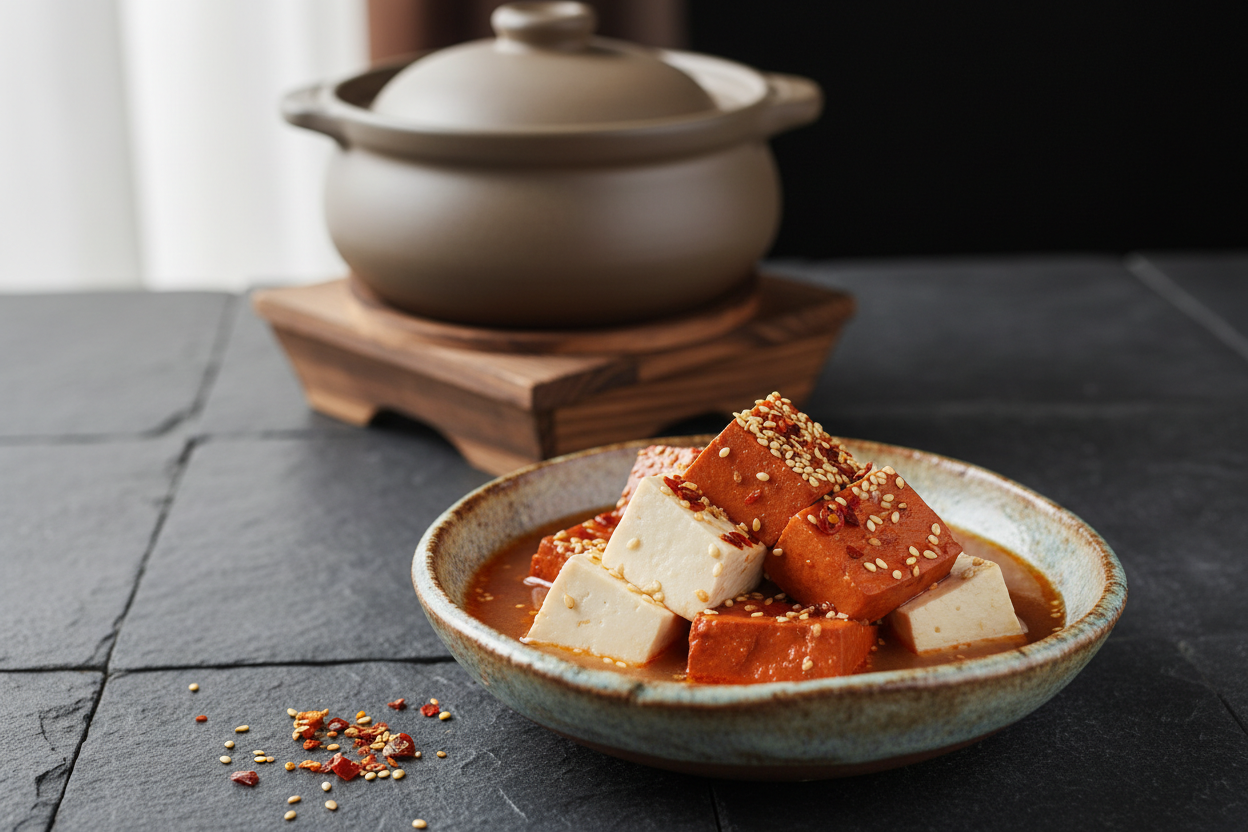
If you have spent time around Chinese home cooking, you may have encountered small glass jars holding pale or red-tinged cubes suspended in brine, rice wine and seasoning, with an aroma that announces itself before the lid is fully open. This is furu, also called fermented bean curd. It is sometimes compared to cheese, a little lazily but not entirely unfairly, because it turns a relatively mild protein into something pungent, savoury and alive with complexity.
Furu deserves more attention in Western food writing because it disrupts a familiar hierarchy. Fermentation is often romanticised when it is European or Japanese, but treated as strange when it is Chinese, pungent, or not already fashionable. Furu asks us to take food intelligence seriously.
What it is and where it came from.
Furu is tofu that has been fermented, traditionally using mould cultures, and then aged in brine, rice wine and seasonings. The result is soft, spreadable and intensely savoury. Chinese fermented bean curd has been part of Chinese culinary practice for centuries, with regional varieties including white furu, red furu coloured with red yeast rice, chilli furu, and wine-fragrant varieties.
The comparison to cheese is useful only up to a point. Like cheese-making, furu uses controlled microbial transformation to turn a plain base into something far more complex. Unlike cheese, it is plant-based, made from soy, and usually eaten as a condiment or seasoning rather than as a large portion of protein.
It is also useful to compare furu with tempeh, another fermented soy food that has travelled more easily into Western wellness language. Both begin with soy and both rely on microbial transformation, but they behave very differently at the table. Tempeh is firm, sliceable and usually eaten as a protein in its own right. Furu is soft, salty, aromatic and used more like a seasoning. Tempeh has become relatively easy to frame as a high-protein plant-based ingredient. Furu is harder to simplify, which may be exactly why it remains so interesting. It asks to be understood not as a meat alternative or a wellness shortcut, but as a condiment, a flavour technology and a piece of Chinese culinary intelligence.
How it is used.
Furu is a seasoning more than a centrepiece. A single cube can carry enough salt, aroma and umami to flavour a dish. It is mashed into marinades, stirred into stir-fried greens, added to braising liquids, or spread very thinly on congee or steamed buns. A little does a great deal.
This is one of the quiet achievements of fermented foods. Fermentation can preserve a food, intensify flavour, reduce waste and make small quantities powerful. It is culinary economy in the deepest sense: not cheapness, but resourcefulness. A simple soybean curd becomes a whole flavour system.
A note on fermentation and the gut.
It is tempting to make grand claims about fermented foods and gut health, and this is where restraint matters. Some fermented foods contain live microorganisms, and fermented foods as a broader category are of real research interest. A Stanford-led dietary intervention found that a high-fermented-food diet increased microbiome diversity and decreased several inflammatory markers over ten weeks. That is interesting, but it does not mean every fermented food has the same effect, or that furu should be eaten in large amounts for gut benefits.
Furu is salty and intensely concentrated. It is traditionally eaten in small portions, which is exactly how it should be framed. Its value is culinary, cultural and sensory first. Any microbiome discussion should remain secondary, cautious and non-promissory.
Why this matters for how we eat.
I love furu because it resists the wellness tendency to convert every traditional food into a health product. Furu was never a modern health food. It was a clever, delicious, economical way to preserve protein and build flavour. That is enough. At Kurami, fermented ingredients matter not because they are fashionable, but because fermentation is one of humanity’s great food technologies: a way of making food more complex, more durable and often more pleasurable.
Camilla Pigozzi Garofalo studied social anthropology and the anthropology of food before founding Kurami, a gut-health meal delivery company focused on plant diversity, balanced nutrition, and sustainable ways of eating. She writes about food culture, eating rituals and the relationship between nutrition and everyday life.
FAQs
What is furu?
Furu is fermented tofu, also called fermented bean curd. It is made by culturing tofu and ageing it in brine, rice wine and seasonings until it becomes soft, savoury and highly aromatic.
What does fermented tofu taste like?
Furu tastes salty, savoury, pungent and deeply umami-rich. Some versions are mild and winey, while others are red, spicy or more intense.
How do you eat furu?
Furu is usually eaten in small amounts as a seasoning. It can be stirred into greens, used in marinades or braises, or spread thinly on congee or steamed buns.
Sources and further reading
1. Wastyk HC et al. Gut-microbiota-targeted diets modulate human immune status. Cell, 2021.
2. Stanford Medicine summary of fermented-food diet trial, 2021.
4. Xie Y et al. Evaluation of sufu fermented using Mucor racemosus M2. Foods, 2023.